
Death as Tie
On burial, belonging, and a name I cannot tell you

The Cemetery
Two weeks ago, I went back to China to move two graves.
China mandates cremation for most of its citizens, but makes an exception for certain ethnic minorities on religious grounds. My family are Hui (回) — Chinese Muslims — and for us, burial in the earth is permitted — a dispensation that is also, depending on how you look at it, a form of being marked.
They had been buried in a Hui cemetery at the edge of the city — one of the designated burial grounds the government approves for recognized ethnic minorities, which sounds more protective than it is. The land the government designates and the land surrounding it are different jurisdictions, and the village controls the latter. The city did not stay at the edge. Hotels and resorts went up along the perimeter. The village allocated the surrounding land for other uses, as villages do when land becomes valuable. Someone planted bamboo along the cemetery’s edge — to screen the graves from the resort’s guests, presumably, so that visitors arriving for a spa weekend would not have to contemplate mortality from their windows.
In Denmark and the Czech Republic, I have walked through cemeteries that double as parks, where people spread blankets on the grass near Kafka’s grave, or picnic a few rows from Andersen’s, as though the dead were simply neighbors who happened to be resting. In China, the feeling is different. The dead make people uncomfortable. They are to be managed, not lived alongside. The bamboo made a kind of sense.
The more serious problem was the wall. The resort had built one across the access road — the road that belonged to the mosque — and fitted it with an iron gate, and locked the gate. The mosque and the resort disputed the road for long enough that the police were eventually called. The dead lay behind their bamboo screen, behind their locked gate, uninvolved and inaccessible.
So we moved them. Moving them meant permits, an imam, a crew, and a morning with decent weather. The plan was to reinter my great-grandmother and my grandfather near my father, who is buried in a newer Hui cemetery across town, beside a plot already reserved for my grandmother, so that the family might be, in death, more orderly than we had managed to be in life. The newer cemetery, like the old one, exists because the government designated it — which is to say, we moved them from one piece of bureaucratic grace to another.
The Compound
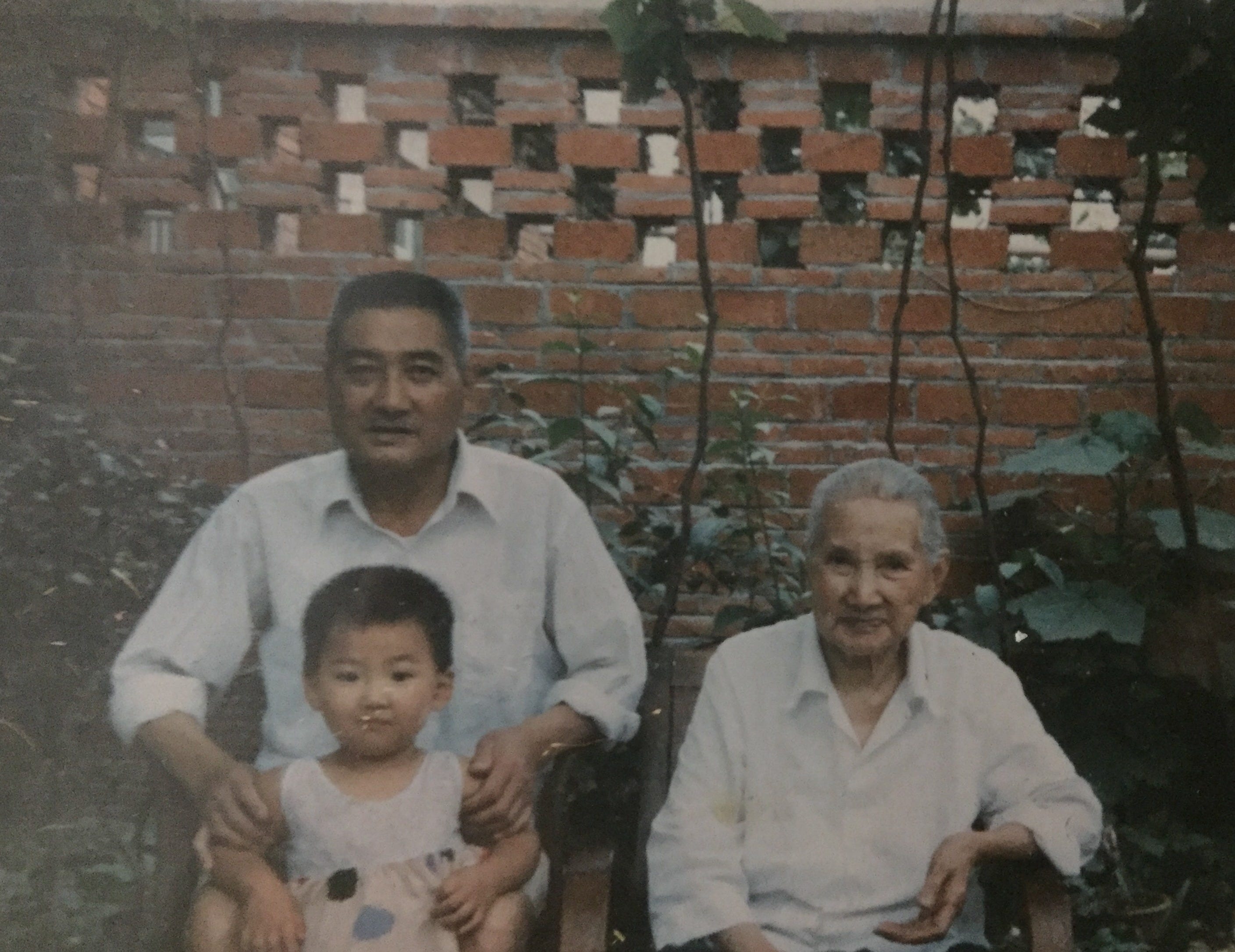
We are Hui in the way that many minority families living among a Han majority learn to be: present at the ceremonies, absent from the daily observance. We lived in a factory compound in a small northern city where my grandfather was a minority cadre — an official designation, a box checked in the government’s system of ethnic accounting, which I have always thought of as a kind of tokenism dressed in the language of representation. We were the only minority family in the compound. I was the only minority student in every classroom from primary school through high school.
I did not feel particularly different, which was itself a kind of achievement — or a kind of loss, depending on how you look at it. We spoke Mandarin. We attended the same schools, lived inside the same walls as everyone else. The children around me were not cruel about it. They were something harder to argue with: casually curious. Some of them called me “little Hui” (小回回, xiǎo huíhui), the way you might point out that someone has red hair. They watched with genuine surprise when I ate certain things. You can eat that? Not hostile. Just certain that I was, in some categorical way, supposed to be different from what I was.
The main visible marker of our faith was that we did not eat pork — or rather, my grandfather did not, and we honored that in his presence. He drank, which is its own theological negotiation. There was no halal butcher in our neighborhood. The most we could do was avoid the obvious. My mother is Han Chinese, and at her parents’ house I ate whatever was on the table, and on the drive home my parents would remind me: don’t mention the pork. So when my grandfather asked what we’d had for dinner, I would say: beef, chicken, vegetables. Various vegetables.
I was perhaps six when I learned this, and I understood it not as lying but as selection — that facts, like guests at a table, could be invited or turned away. You choose which to present. You leave others outside the door.
My great-grandmother was the truly observant one. I knew her as very small, very old, and very certain. Every morning her washing took unusually long — I would hear her in the bathroom, and sometimes watch from the doorway: the careful sequence of it, the rinsing of hands, the cleaning of the nose, the face washed in a particular order I did not understand and did not think to ask about. I know now that she was performing wudu, the ritual ablution Islam prescribes before prayer. At the time I knew only that she was very thorough, and very unhurried, and that the bathroom would smell faintly of water when she was done.
She had lived with us all my life. She spent her days in her chair by the window, shelling sunflower seeds and handing them to me one by one when I came home from school, watching me swallow them all at once. She often wore the same grey crossed-front shirt every day — the kind elderly Chinese women have worn for a century — her white hair combed flat with a fine-toothed comb and pinned into a tight bun. She walked with a cane. Her feet had been bound in childhood, and they had never unbound themselves from what that had made them: two small compressed things that had carried her across nearly a century.
The Mosque
Years ago I wrote an article about the decline of Buddhism in Japan. Many of the Japanese friends I interviewed told me the same thing: the first time they had ever set foot in a temple was for a family funeral — that a tradition they nominally belonged to had remained abstract until death made it concrete. For me it was the same. The first time I set foot in a mosque was for my great-grandmother’s funeral. I was eleven.
We traveled to a mosque in a neighboring city, and I was given a white cap and had white cloth tied around me, and it was winter. She was laid out on a stainless steel washing table in a room inside the mosque, behind a curtain of white cotton. Islamic tradition requires that the body be washed before burial — a thorough bathing administered by the living on behalf of the dead, in water that cleans away something harder to name than dirt. After the washing she was wrapped in layers of white cotton, the kafan, which is all a Muslim is permitted to take into the ground. No coffin. No flowers. No objects of any kind. You arrive in the world with nothing; the faith asks that you leave the same way.
The adults told me to go look at her one last time. I did, and I touched her arm, and she was cold in a way I had no word for — not cold like a window or a floor, but cold in the way that makes your hand understand, before your mind has caught up, that the person is entirely gone. I pulled my hand back quickly. It was the first time death had been something I could touch.
There was to be no weeping. Weeping, I was told, would hold the spirit here, would keep her from leaving. So the mourners stood quietly while the imam chanted. The funeral prayer in Islam is called the salat al-Janazah: the congregation stands — no kneeling, no prostration — and the imam prays on behalf of both the living and the dead, asking forgiveness for all of them. For a ceremony marking the end of a life, it is startlingly brief. I have come to think there is theology in that brevity: the dead are not waiting for us to finish grieving. They have somewhere to be.
There is a word Hui Muslims use in Chinese for dying: wúcháng (无常) — impermanence, the condition of being without permanence. It is not a Quranic term; the Arabic word for death is mawt, and the more devout say guīzhēn (归真), returning to God. Wúcháng is something the Hui made for themselves, somewhere between Chinese philosophy and Islamic faith, which is perhaps the only place we have ever really lived. Standing in the cold that winter, I did not know any of this. I was eleven, and I had just learned that you could touch a dead person and feel the absence of them as a physical fact.
Afterward, the family made you’xiang (油香) — plain rounds of fried bread, golden, smelling of hot oil — and distributed them to the neighbors and friends who had come. It is what Hui families do after a death. Other communities send flowers; we sent bread you could eat. Grief, after all, is hungry.
Only male relatives were permitted to ride in the truck that carried her body to the cemetery. I was eleven, and a girl, and I watched the metal tailgate begin to rise. The idea in my mind was very simple: I wanted to go with her. I had handed her sunflower seeds every afternoon of my life. I had watched her comb her hair. This was the last road she would travel, and I wanted to be there for it. I judged my moment, and in the last second before the tailgate closed, I stepped up onto the flatbed.
Nobody stopped me in time.
My grandmother — her daughter-in-law — remembered this for years, and brought it up more than once. My defiance, she said, had shown itself early. I think, though she never said so directly, that she did not entirely disapprove.
At the grave, the imam chanted the burial prayers, and my great-grandmother was lowered into the earth in her white wrapping, the pit sealed with stone slabs. The women who had washed her body said she must have been a woman of deep faith: even in death, her hands had settled into the gesture of iman, of belief, as though her body knew what to do without being asked. I did not know what iman meant. I was eleven, standing in the cold, still feeling the cold of her arm in my hand.
The Hospital
My grandfather passed away two years later. This one was harder to absorb.
He had raised me, more or less. He walked me home from kindergarten every day, made my breakfast, grew fruit trees in the courtyard — loquat, fig, cherry, grape — so that in summer there was always something to pick. He made borscht from a recipe I never thought to ask about, rich and dark red, the most improbable thing for a Hui man in a northern Chinese city to have learned to cook. When he had a stroke and was hospitalized, barely able to move, he would still raise one finger toward the bedside cabinet when I came to visit — to indicate there was something good inside, as there always had been. I cut his nails one afternoon and nicked the skin. My aunt scolded me. He waved her off with great effort and said, in the slurred and halting way he spoke by then, that it was nothing. Then he told her to leave me alone.
Everyone knew he favored me. In a family where a grandson had come along — a boy, which in Chinese culture is supposed to settle these things — he had never pretended otherwise. There was an evening near the end when his right hand still had some strength. He raised it toward me suddenly, and I took it, and he held on harder than I expected, and I held on too. I turned my face into his hand and stayed there, and if I cried I tried not to let him see it, because the adults had said it would upset him. We stayed that way for a while. I wanted time to stop, in the way that people want things that cannot happen. He died a few nights later. The phone rang late, which is never good news.
By the time we reached the hospital, his body had already been wrapped and placed on the floor, oriented to face west — toward Mecca, which lies west of China, and toward which a Muslim’s body is turned at death as it is turned in prayer throughout life. The adults had already cleaned the wooden boards needed to carry him, already arranged a truck, already contacted the mosque. I had seen them preparing the boards days before, when he was still alive, and I was furious. I said it was morbid, inauspicious, wrong. I was a teenager, which is to say I understood grief and nothing else. What I did not yet understand was that preparation is its own form of love — that the adults around me were doing, in the middle of their own sorrow, what had to be done regardless of whether anyone felt ready. The dead cannot wait for the living to finish being shocked.
That was my first lesson about death: it arrives whether or not your feelings about it are in order.
The Reinterment
It had rained the day before the reinterment. The crew arrived at six in the morning and began to dig. By ten they had reached the stone slabs.
When they lifted the slabs, there were bones. Brown, whole, twenty-some years in the ground. The senior imam — who had presided at both original burials and had come again now, older, to oversee this one — stood at the edge of the pit. It was a younger imam who climbed down, lifting the bones out by hand, one by one, and laying them carefully onto white cloth spread beside the pit. For the smaller fragments that had worked their way into the soil, he used a flat plastic trowel to lift them out, then separated the bone from the earth with his fingers.
My grandfather’s burial cap was still there. The original white wrapping had survived intact. The imams said it was the most intact reinterment they had done in years; the rain the day before had worried them, they had brought a water pump, but the graves were dry and undisturbed. The senior imam looked down at what remained of my grandfather and said that a man whose grave had kept this well must have lived a good life, must have done good in the world. I am not a believer in any way I could defend. But standing there, I found I wanted it to be true — that a good grave means a good life, that the earth keeps score of something. I did not know if this was theology or comfort. It was probably both.
On the day of the reinterment, I learned from a conversation between my cousin and the imam that we are Sunni — which is a branch of Islam, which is a religion I nominally belong to. Standing beside an open grave in the summer heat, learning this for the first time at thirty-something years old, I found I was not surprised. I could not tell you what being Sunni means in practice, because nothing in my upbringing made it mean anything in practice. It is a label I carry the way you carry a middle name you never use: it is yours, technically, but it has never been introduced.
In our tradition, funerals are organized by the mosque — the washing, the prayers, the burial, everything. The carrying case belongs to the mosque too, not to any family. My cousin and I carried the bundled remains to it — the communal steel box, draped in cloth embroidered with Quranic verses, used for every Hui burial in the community and returned after each one, because the dead borrow their passage out of the world and give it back. The bundles were light in my arms. They were also not light at all. I have tried to find a way to say this that doesn’t sound like a paradox, and I cannot.
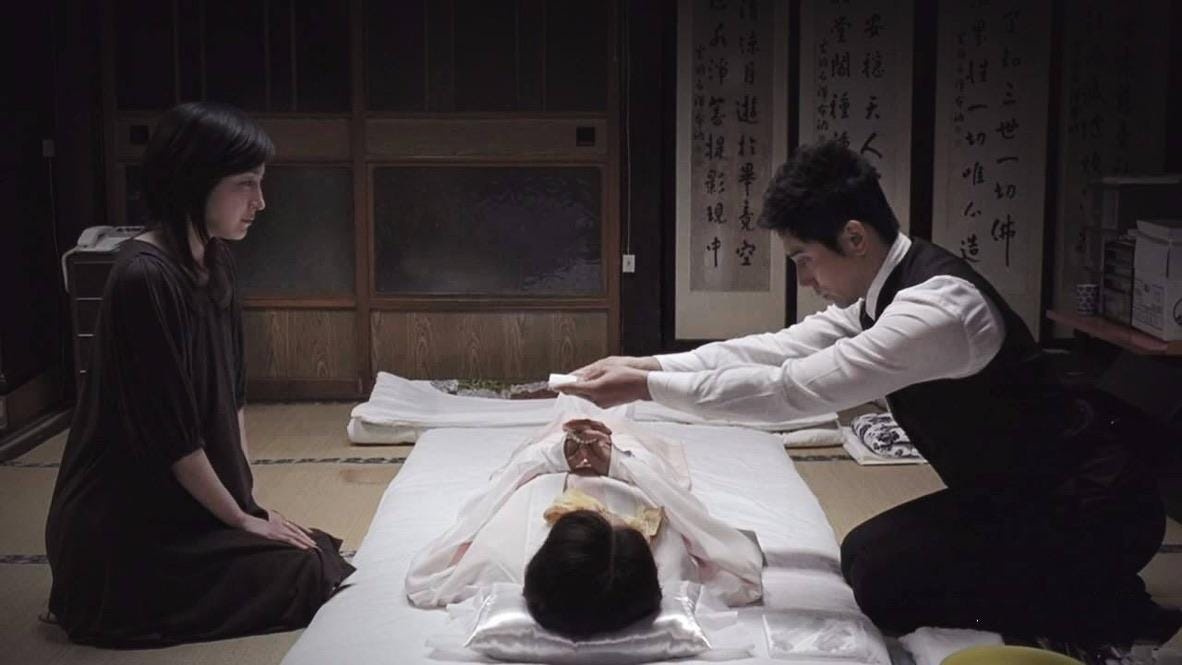
At the new cemetery, the imam climbed into the grave and tacked fresh white cloth along the walls, and we lowered the bundles in, and someone scattered spices, and thin smoke rose in the summer air. I thought of the Japanese film Departures, about a man who prepares the dead for burial — the care he takes, the precision, the way he handles each body as though it still matters how it is touched. It does, I think. It always did.
The imams took turns chanting at each new grave — the same prayers as the first burial, beginning again as though no time had passed. At the end they raised both hands, palms up, and drew them slowly down across their faces. I have seen this gesture at every Hui funeral I have been to — which is not many; only these two, and the anniversary ceremonies in the years between — and I still could not tell you its name or exactly what it means. But standing there in the summer heat, I found the chanting beautiful for the first time — not because I had come to understand it, but because I had stopped waiting for understanding to arrive before I was allowed to feel it.
I handled all of this without weeping, which surprised me somewhat. I am not a composed person by nature. But I have been to enough funerals to understand that the body knows what is needed of it, and what was needed here was steadiness, and so I was steady. It was only later, driving back, that I began to think about the distance between the eleven-year-old who had stood at a Hui burial and understood nothing — not the prayers, not the rituals, not what iman meant. How much ground I had covered. How little of it showed on any map.
After
This is how my education in my own tradition has always gone: in fragments, at funerals, from the side of a grave.
Perhaps it was the funeral that prompted it. A few weeks after we buried my great grandmother, my family decided I should be more connected to the tradition I had been circling my whole life without entering. The mosque’s senior imam wrote me a name in brushstroke on a sheet of white paper: an Arabic name, a Muslim name, one that carried a meaning he explained and that I have since forgotten. I don’t know where that paper is now. I never used the name. I cannot tell you what it said. It was an attempt — by him, by my family, by something — to give me a thread back. The thread did not hold. Or I did not hold it. I am not sure there is a difference.
I am still not a practicing Muslim — which is almost not the right way to put it, because it implies an absence I notice. Mostly I don’t. It is an identity I forget I carry, the way I forgot the name written on that sheet of white paper — until something reminds me: a funeral, a grave, a conversation beside an open pit in which I learn, at thirty-something years old, that we are apparently Sunni. I still eat pork when I feel like it. I am still the only Hui person in most of the rooms I enter. I have made a certain peace with not knowing what I am, exactly, or what any of it means in practice.
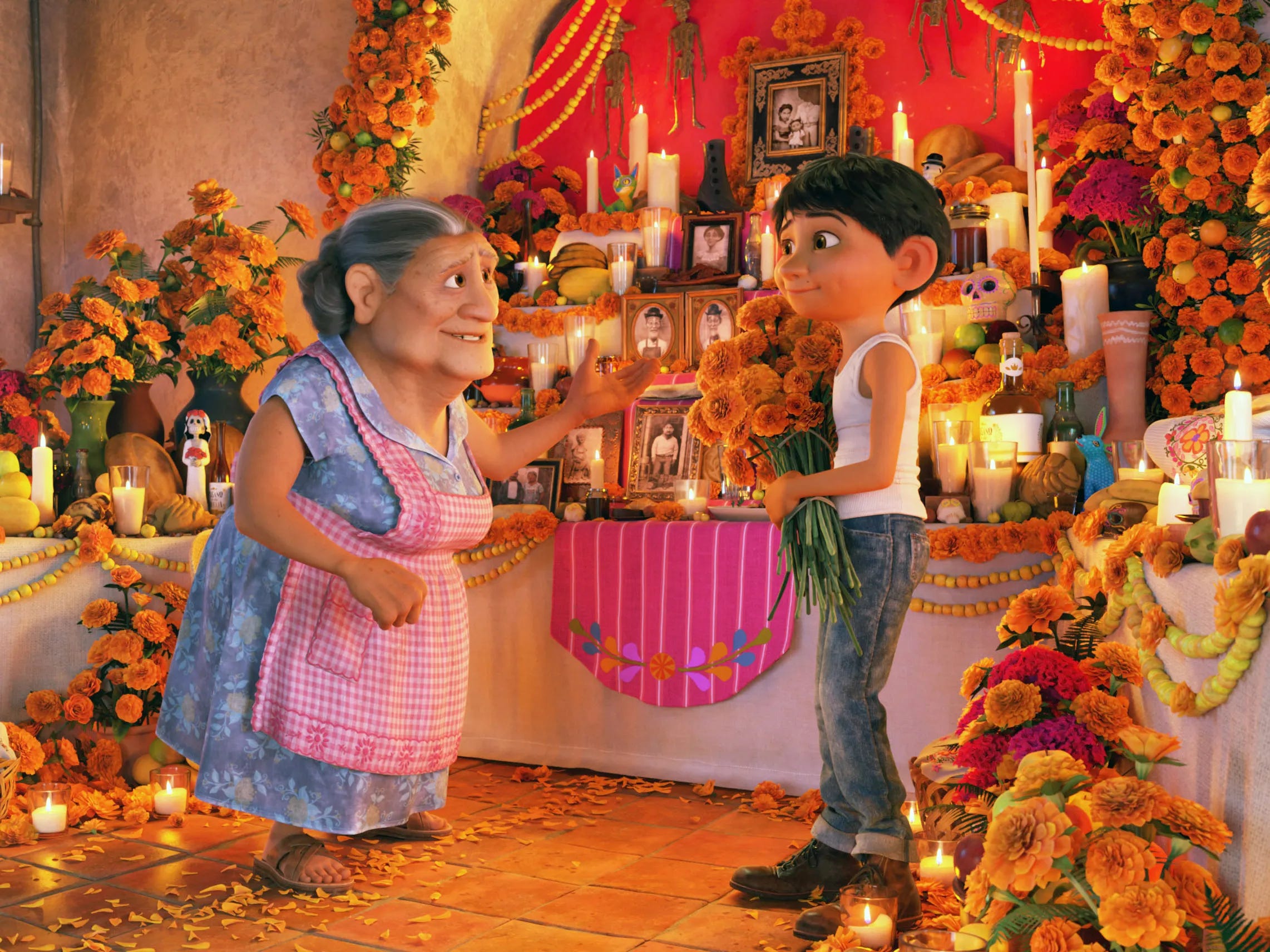
What I have, instead of practice, is this: I was present at their deaths, and present again when we moved their bones. After the reinterment I found myself reading about Hui funeral rites — matching what I had seen against the names and meanings I had never known to ask about, filling in the gaps twenty years late. There is a Pixar film called Coco, about the Day of the Dead, built around the idea that the dead disappear only when the living stop remembering them.
I am not sure I believe that. But I think about the name on the white paper — the one I was given and lost, the one I cannot tell you — and I think: some things disappear whether or not anyone stops remembering. The bones were still there, brown and whole, twenty-some years in the earth. The name was gone in a decade.
I don’t know what that means. I am not sure it means anything. But I carried the bones, and I know where they lie now, and that is the closest I have come to knowing where I belong.
It was only after this summer that I stopped to think about the word itself — wúcháng, the word the imams use, the word the adults around me have always used. I had heard it at every funeral I attended without once pausing to consider what it meant to say it that way: not dead, not gone, but impermanent. As though impermanence were not something that happens to us at the end, but the condition we have been in all along. As though living and wúcháng were not opposites, but the same thing seen from different distances.
I find that more honest than most words I know for death. I also find it, unexpectedly, a kind of comfort.
Lovely reflective piece, thank you!
I knew a Hui girl in Beijing for quite a few years. She was originally from Shandong. We even worked together for a while.
She didn't eat pork, but as far as I could tell, that was the only fragment of Islam that she still carried with her. I once visited the historic mosque in 牛街 with her, and it was clear she had received no Islamic education of any kind and didn't know even basic facts about the religion. I am certain she would not have known that her community is Sunni. After reading your piece, however, I wonder if she may have had more contact with Islamic practice than I assumed.
I have visited places in Western China, like Ningxia and Qinghai, where there seem to be Hui communities that still follow their religion and are more obviously distinct from the Han. I wonder if it is because there are more of them living in close proximity, or because they are more geographically remote.
what a beautiful piece, thank you for sharing this