
Faces on Lamp Posts
On voting for the first time, at 39, in a country that is not your own

Spring is officially here. It is seven degrees outside.
I should explain that I am a person who used to belong entirely to warmth. Hot summers, heated rooms, the sun at its most direct and unambiguous — these were my conditions. Cold was something to be endured, briefly, before returning to somewhere sensible. Then I moved to Denmark, and five years passed, and something changed that I cannot fully account for. I have heard it said that the body, given enough time in a place, reorganizes itself: the fat redistributes, the metabolism recalibrates, a person becomes, in some cellular way, native to the climate. I am inclined to believe this. Seven degrees now feels like an opening, like a door swinging outward. I walked for an hour the other day in a single cotton jacket and came home sweating.
Spring here is less a matter of temperature than of light. It begins in February, quietly, almost furtively — the afternoons lengthen by minutes, and then suddenly by something you can actually feel. The flowers are starting now, scattered and tentative along the paths. And in the forest, the wild garlic is nearly ready.
This matters to me more than it would to most people. I grew up eating garlic chives, which are easy to find in China and nearly impossible to find in Denmark, and the wild garlic that grows freely in the Danish woods each spring has become my seasonal consolation — a gift from the forest, free and abundant, arriving exactly when I am most ready for it. It is one of several reasons I have come to love this season.
And Happy Lantern Festival! 🏮
I had almost forgotten it. It was nearly noon when someone posted a photo of tangyuan and I remembered. I put on my coat and took the bus to three different Asian grocery stores. All of them had sold out. So I decided this is my “tangyuan” :
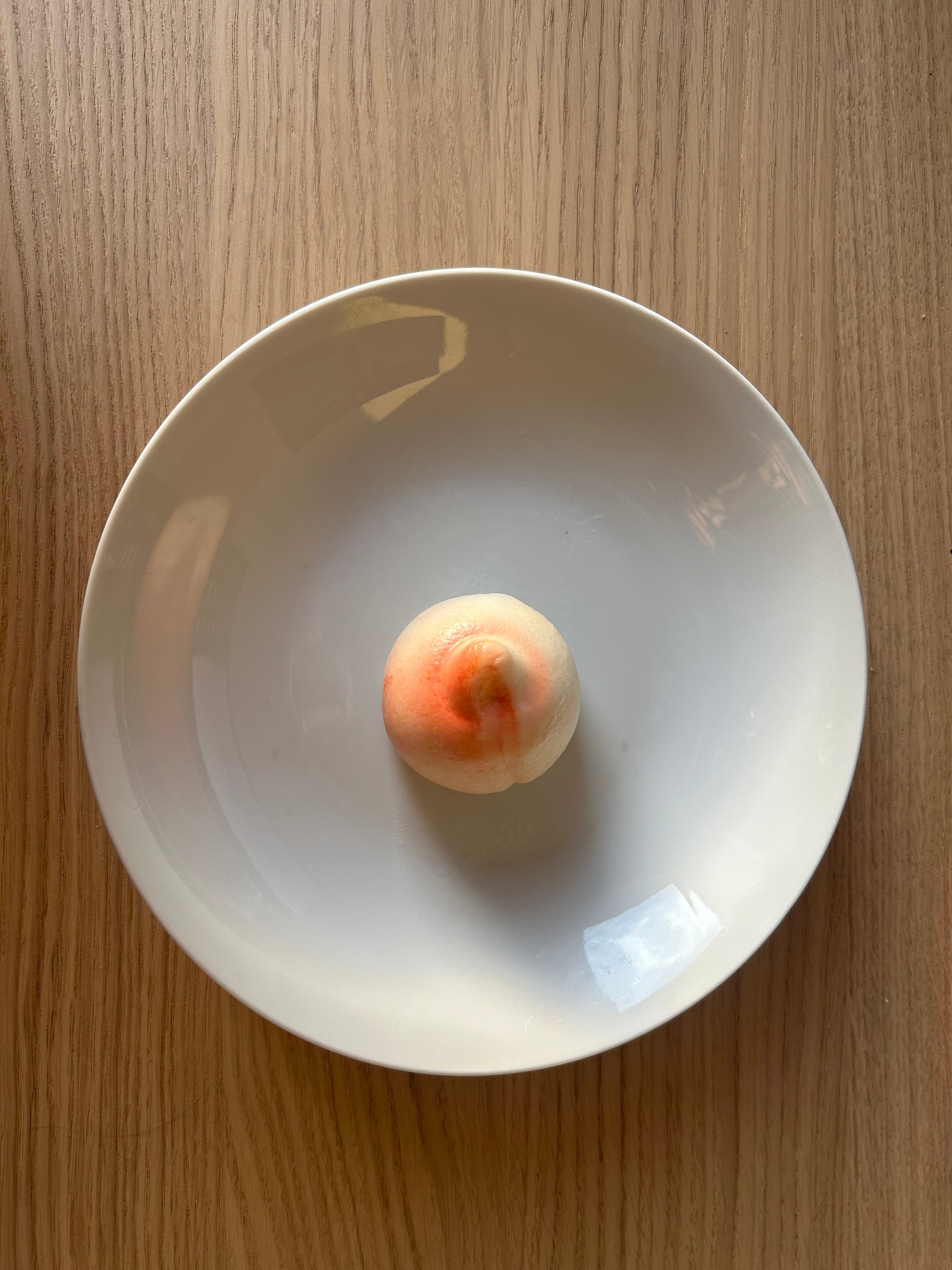
A longevity peach — the white, round, bean-paste-filled bun made for elderly birthdays, the kind you bring to a grandmother turning seventy. It is white. It is round. It is filled with something sweet. I am choosing to count it. You have to make do with what you have.
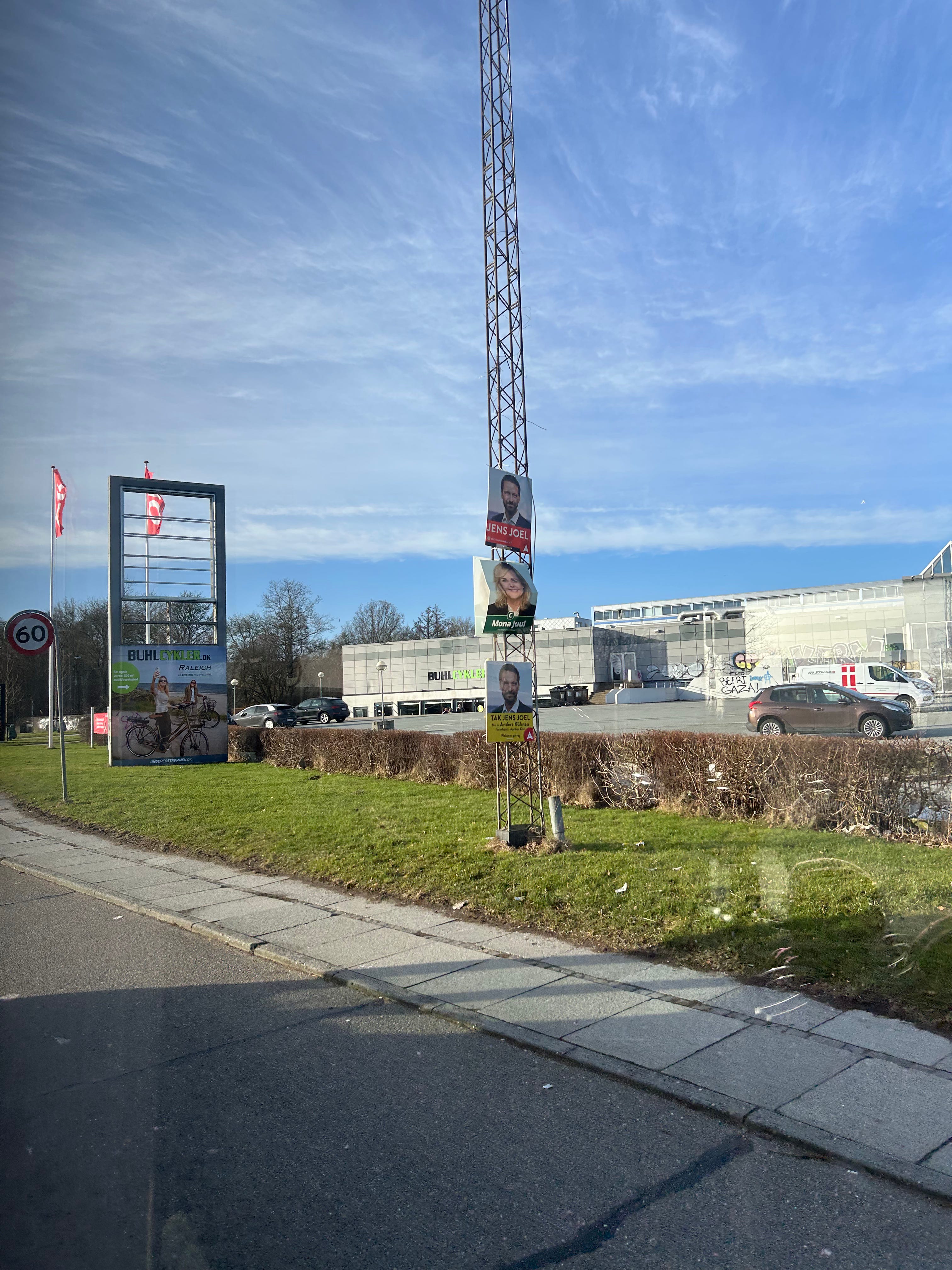
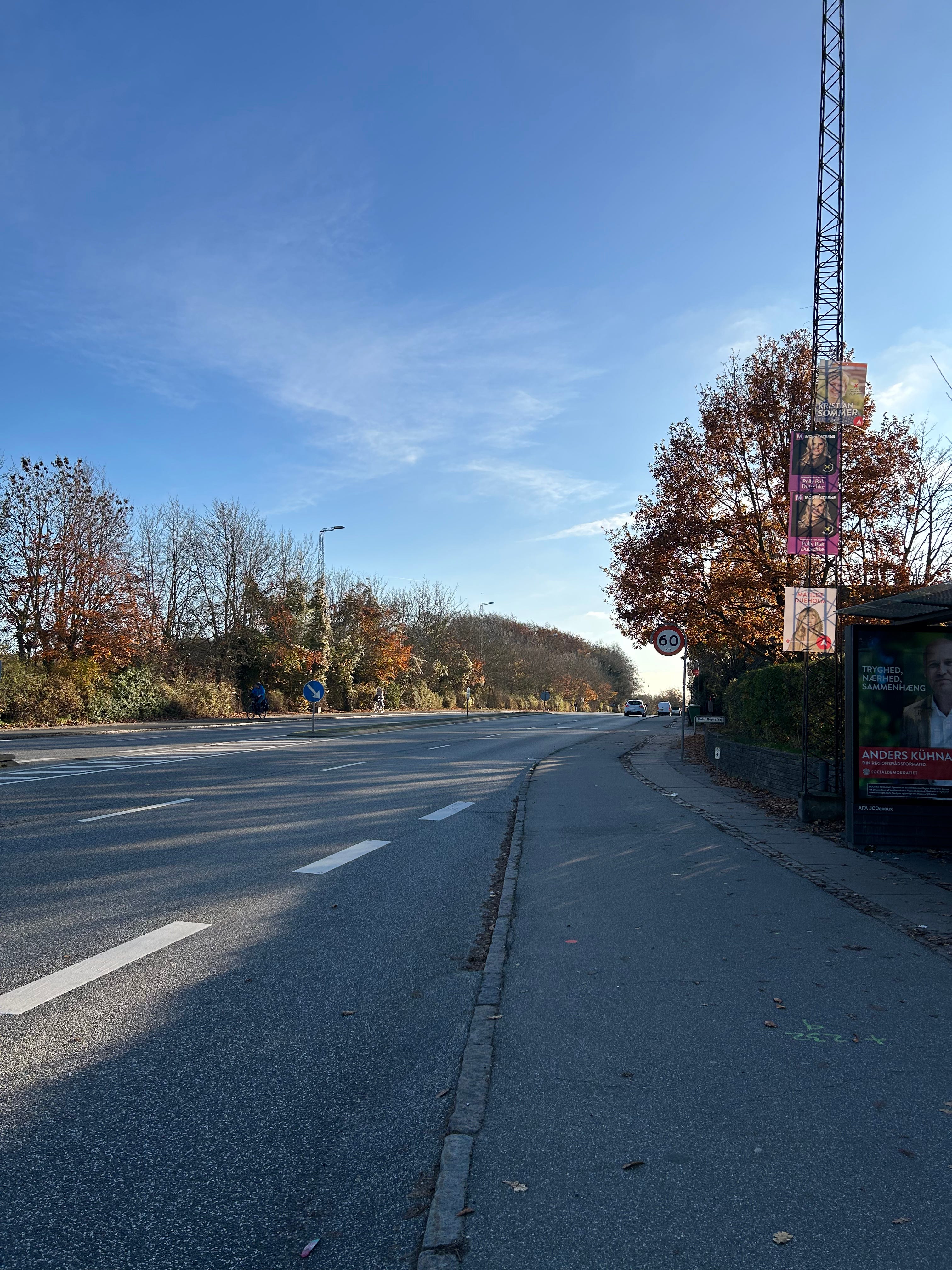
On the bus there, I noticed the lamp posts. This required no effort at all: it was the third day of March, and the sun was doing something it had not bothered to do in some time, which was to actually show up. The light came in flat and generous across the rooftops, and the city looked briefly like a place that had decided to be pleased with itself. It was the kind of afternoon that makes you feel obscurely that things are going to be fine. And there they were, in all that brightness: faces, smiling down from the railings and the fences all the way into the city center, catching the light.
Danish elections are normally scheduled with the same consideration that goes into everything else here — June or November, when Danes are neither deep in their summer holidays nor bracing for Christmas, and when the light is cooperative enough that standing in line feels like a reasonable thing to do. The vote was not supposed to come until October at the earliest. But five days earlier, Danish Prime Minister Mette Frederiksen had walked into the Folketing and called a snap election for March 24th.
The reason, she said, was Greenland. Donald Trump had spent the winter making increasingly explicit threats to annex the island, and Frederiksen had spent that same winter becoming, in the eyes of Danish voters, the person standing between Denmark and whatever came next. Her poll numbers had nearly doubled.
The announcement landed in party offices like a starting pistol — except that in this race, the first thing you sprint for is not votes but lamp posts. Printing schedules were pulled forward. Zip ties were ordered in bulk. Teams of young volunteers were dispatched with ladders and measuring sticks, because the law requires every poster to hang at least one-and-a-half meters below the power lines, and the starting gun fires always at the same moment: precisely 28 days before the vote, always at noon. There is a competitive frenzy to it. The bridges and the fences fill up. The law forbids removing a rival’s poster once it is hung, which means that position, claimed early, is permanent. Train stations are the crown jewels: every commuter, every traveler, every person squinting at a departure board must pass beneath a gauntlet of faces, and to have your poster at the central station is to have won something before a single vote is cast.
Standing in the mild sunshine, it was difficult to imagine that somewhere far to the north, on an enormous island most Danes have never visited, a question of sovereignty was being contested by forces well beyond this small country’s control — and that this vast geopolitical drama had now been zip-tied, quite literally, to the lamp posts outside my door.
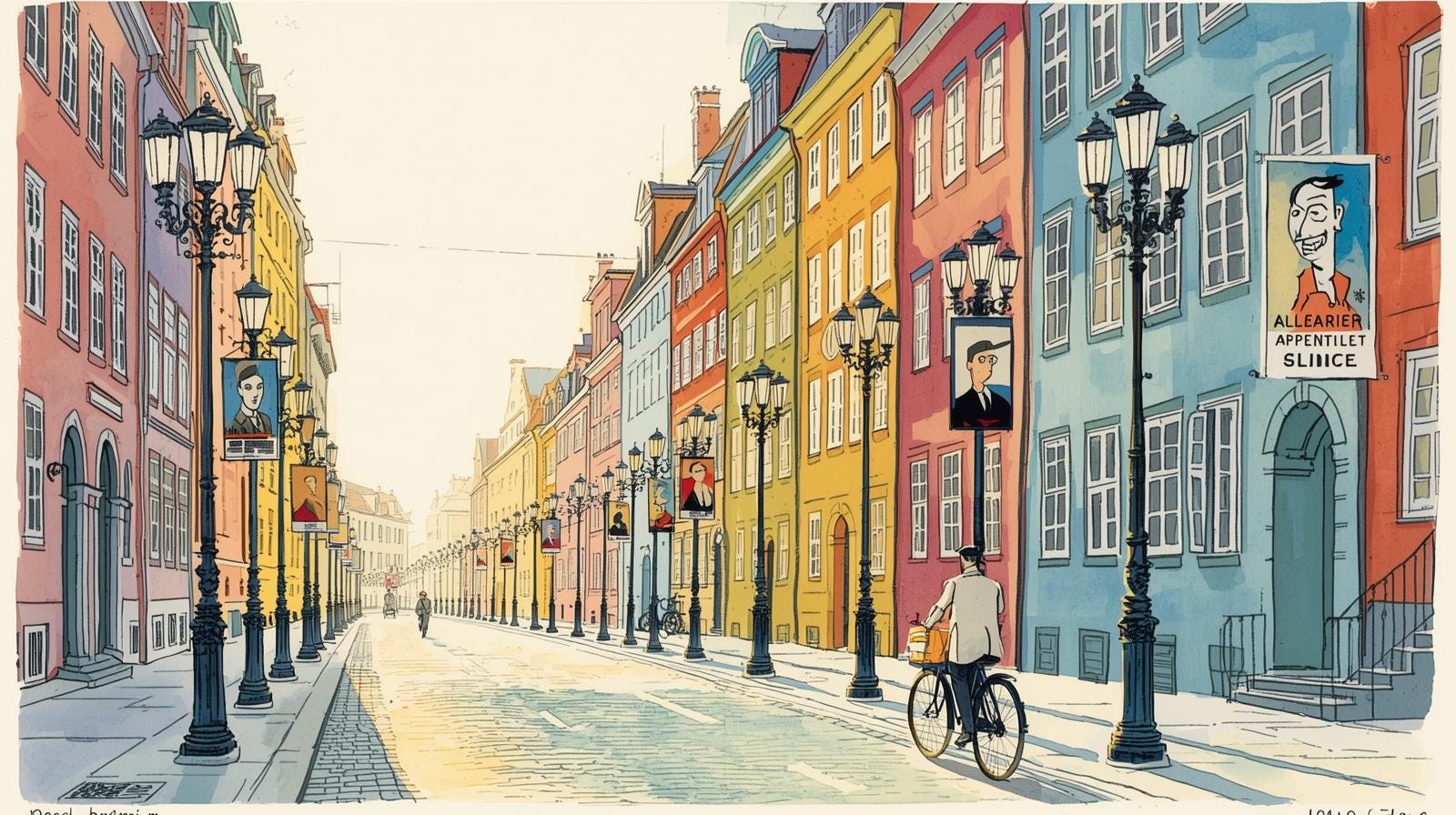
And there they were already, on the third of March, in all that unseasonal sunshine: the faces. Smiling down from every lamp post and bridge railing and stretch of fence, one after another, all the way into the city center. Every time an election approaches in Denmark, this is the first sign — not a news alert, not a television advertisement, but a face, zip-tied to metal at the legally mandated height, looking down at you with carefully calibrated warmth. The posters themselves are curiously uniform for a country so devoted to design. A face. A name. A letter and a color indicating the party. That is all — no promises, no slogans, no hint of what the candidate intends to do if given the chance to do anything. Apparently that is your business to discover on your own. The face simply presents itself, hopeful and enormous, like a neighbor who has climbed onto the roof to wave at you.
The last time I had seen them was 28 days before the 18th of November, which was the day I cast my first ballot in a local election, which was also the first vote I had ever cast in my life.
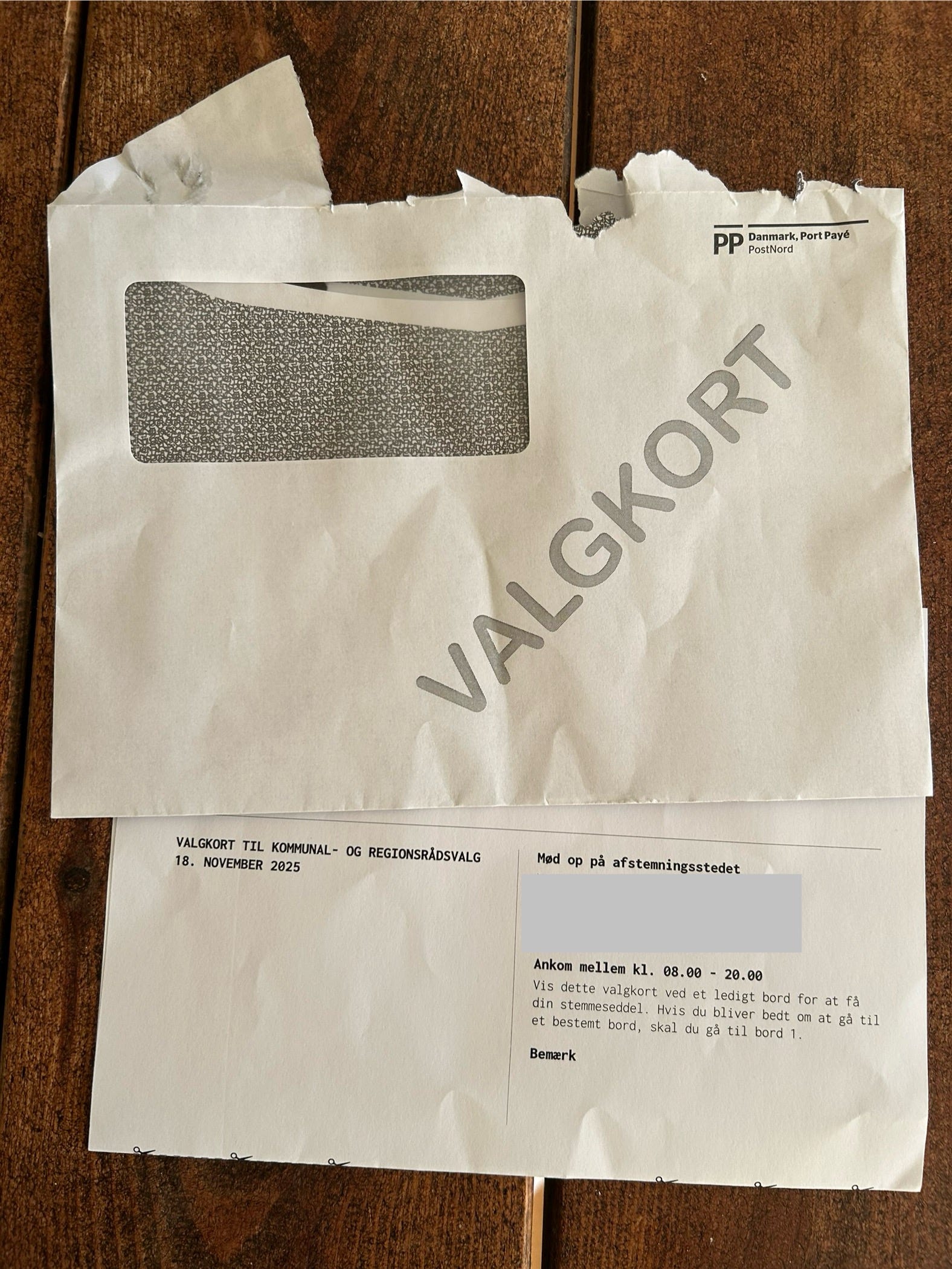
It was a local and regional election, and in Denmark, foreigners are permitted to participate in these: any EU citizen, any UK citizen, any non-EU citizen who has lived in the municipality for four consecutive years. I have lived here for five. When the voting slip arrived in my mailbox, I stood in the hallway and looked at it for a moment. I had grown up in a country where this was not a thing that happened to you. The slip was unremarkable, a piece of paper, a list of bureaucratic instructions, the kind of thing you might mistake for a utilities notice. But I held it with a certain attention, and then I held it a little longer, and if anyone had been watching they might have wondered why a person was standing alone in a hallway, staring at a piece of paper, trying very hard not to make any noise.
To be a responsible voter I researched the parties, which in Denmark requires some effort. There are thirteen at the national level, and more locally, though the main ones arrange themselves across a familiar grid. To find your political position in Denmark, you first have to learn to breathe inside a complicated grid.
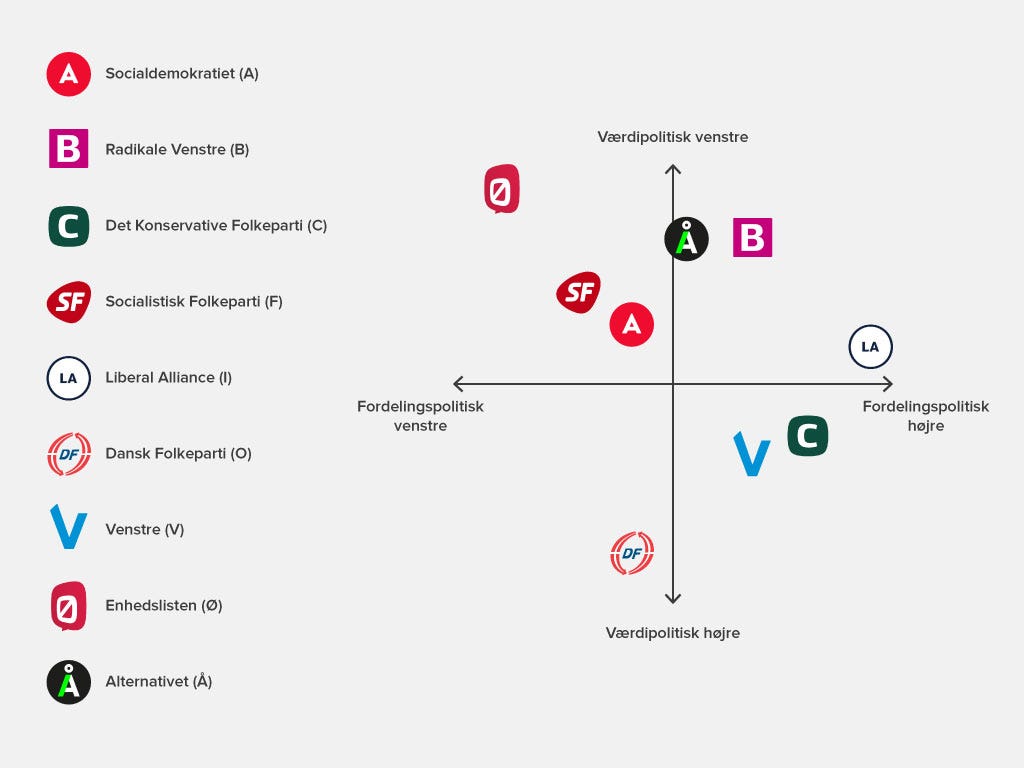
The parties arrange themselves across two axes: one running from big government on the left to free market on the right, another from socially open at the top to socially conservative at the bottom. Enhedslisten (the Red-Green Alliance) sits in the upper left with actual communist roots. Liberal Alliance — the name, for once, meaning almost exactly what it says — occupies the lower right, essentially the Danish libertarian party. Dansk Folkeparti (the Danish People's Party) anchors the lower middle, the populist party that has built its identity around the proposition that Denmark belongs, in some essential way, to the Danes.
Near the center sit Socialdemokratiet (the Social Democrats) and Venstre, whose name means simply "Left," a historical artifact that no longer describes its politics, which are firmly center-right. They are closer to each other than either would perhaps prefer to admit, two large parties that have dominated Danish politics for most of a century, both fairly conservative on immigration, both reluctant to stray too far from the economic middle. Their proximity on the chart reflects something true about the Danish electorate: cautious, practical, attached to its welfare state, and deeply ambivalent about the world beyond its borders.
Except that last November, the ground shifted. Socialdemokratiet lost more than five percentage points across the country, and in Copenhagen they lost something they had held continuously since 1938: the lord mayoralty. The party’s municipal seats shrank from 44 to roughly 25. The new lord mayor of Copenhagen came from Socialistisk Folkeparti (the Socialist People’s Party). The city’s single biggest party remained Enhedslisten, with 22 percent. Copenhagen went left — just not the left that the prime minister had in mind. It was, by any measure, a historic defeat. And then Trump started talking about Greenland again, Frederiksen’s numbers climbed back up, and she called the election before the moment could pass.
Denmark is a multi-party democracy, which means governments are almost always coalitions, and coalitions require negotiation, and negotiation requires that people with genuinely different views find ways to share a table. This produces a different quality of politics than a two-party system does — less polarized, more fractured, more given to the kind of unglamorous compromise that does not make for good television but does, over time, make for a functioning country.
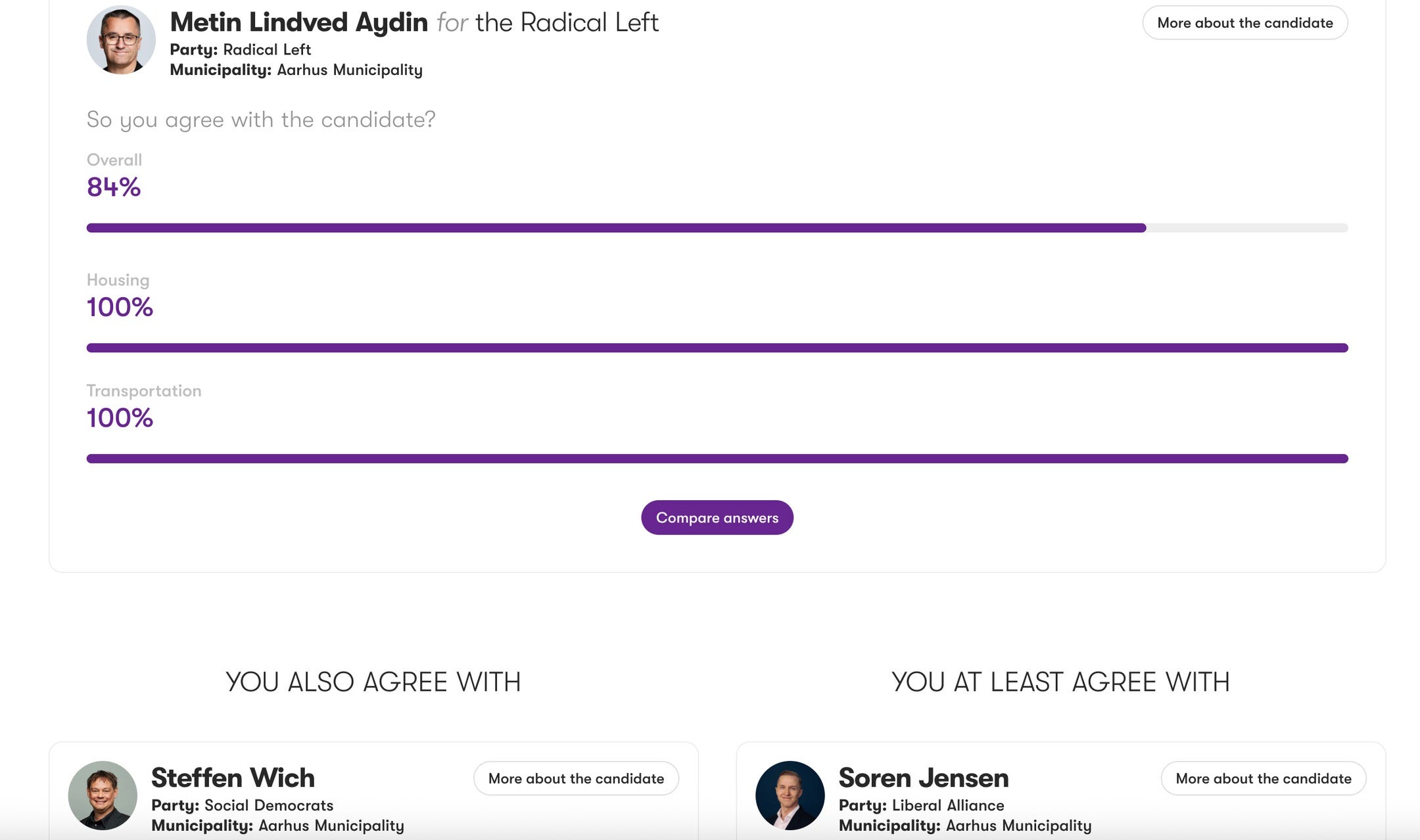
Before each election, many newspapers offer questionnaires: you enter your opinions, and the questionnaire tells you who you are, politically speaking. I took one — the kind that asks you to slide a little bar between agree and disagree on thirty questions about tax rates and immigration and the proper role of the state, and then pronounces judgment on your soul.

Mine came back: Radical Left.
The name sounds alarming in the American ear, conjuring barricades and pamphlets. In Danish it is Radikale Venstre, which translates, with some mischief, as exactly that, though the party is in fact a social liberal one, occupying the progressive center rather than any revolutionary fringe. They are the party of the educated professional class: academics, architects, journalists, people who hold strong opinions about urban planning and feel personally implicated in the state of the world. They believe in open borders, a generous welfare state, and the kind of cosmopolitanism that makes them instinctively sympathetic to foreigners. They believe that Denmark’s soul should not be reduced to a single ethnic shade, that every person who arrives on this small, flat, wind-battered peninsula brings something the country did not have before. They cite statistics and love the arts. They are internationalists in a country that is, at its center of gravity, not entirely sure about internationalism.
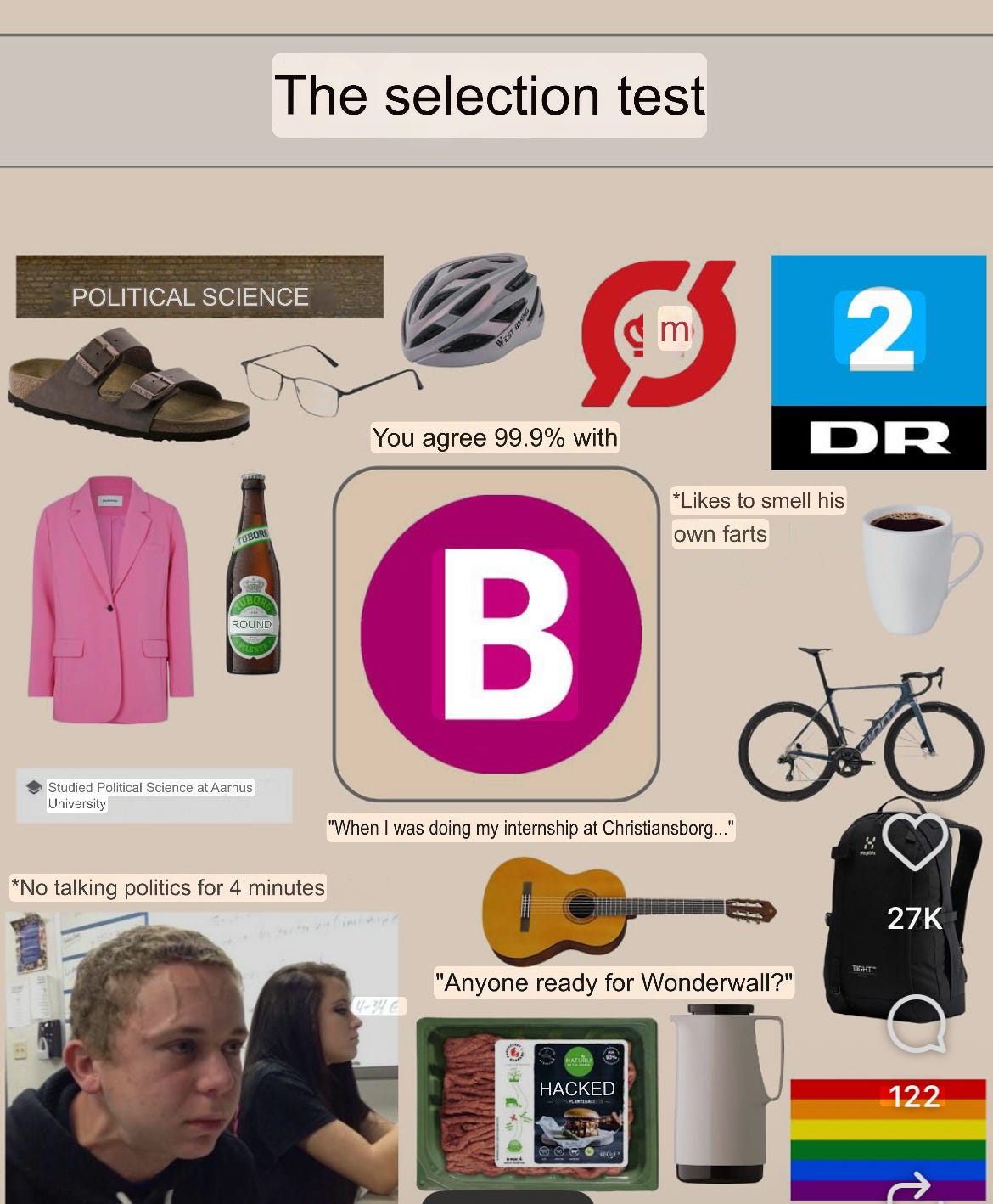
The Danish internet promptly confirmed this diagnosis. Someone had made a meme cataloguing the Radikale Venstre type: Birkenstocks, thin-framed glasses, a bicycle helmet, a pink blazer, a Tuborg, black coffee, political science studied at Aarhus University, DR and TV2 for news, a guitar producing Wonderwall at the slightest provocation, a pride flag somewhere in the frame. They are, in the taxonomy of the meme, the people who cannot go four minutes without talking about politics — and who would, if pressed, argue that four minutes is not nearly enough. It was, in several uncomfortable respects, me.
The polling station was eight minutes from my front door, in the gymnasium of a local school. I went after work. People arrived on foot and by bicycle; an old man came in a wheelchair; someone maneuvered a stroller through the door with the practiced efficiency of someone who had done harder things. There was a queue, orderly and unhurried, the way queues in Denmark tend to be. You gave your phone number. You received your ballot. You went to a booth.
I stood in the booth for a moment before I marked anything.
Denmark turns out about 70 percent of its voters for local elections, 85 percent for nationals. I had grown up in a country where elections exist but mean something different — where the parliament is, in the dry phrase of political scientists, a rubber stamp, where the results arrive at 100 percent, where the process is more ceremony than choice. I had spent my adult life watching other countries’ elections from that distance: the counting, the concession speeches, the genuine uncertainty of a night when nobody yet knows. And now I was inside one. I marked a name, and the name I marked might actually matter, and I felt something I did not entirely expect to feel, which was that I wanted to cry.
I wanted someone to take my photograph. I was too shy to ask. There is something quietly humiliating about turning 39 and casting your first vote — not because of any failing of your own, but because of the simple accident of where you were born and how the world is arranged. It is not the kind of thing you explain easily to strangers in a gymnasium. So I folded my ballot, and fed it into the box, and walked back out into the evening, and kept it to myself.
That vote, as it turned out, had witnessed something. Across the country, and most dramatically in Copenhagen, Socialdemokratiet was losing ground it had held for nearly a century. I did not know that yet, standing in the gymnasium in Aarhus. I only knew that I had done it, finally, at 39, on a November evening in a country that was not the one I was born in.
Four months later, I carried my longevity peach home through the March sunshine, past the lamp posts with their new faces. It was not what I had gone out looking for. But I have come to think that this is beside the point. The peach was mine, and it was enough — the way a first vote is not grand or ceremonial but is simply a small, irrevocable thing that fills a space you did not know was hollow until the moment it was filled.
Next time, I have decided, I will be there on the day the starting pistol fires. Noon, precisely 28 days before the vote. I want to watch them do it — the ladders, the zip ties, the young volunteers sprinting for the best positions. I want to see who gets the lamp post outside my door.
It is also yours now.