
Fødselsdagsflag
On Birthdays, Flags, and the Math That Never Quite Works Out

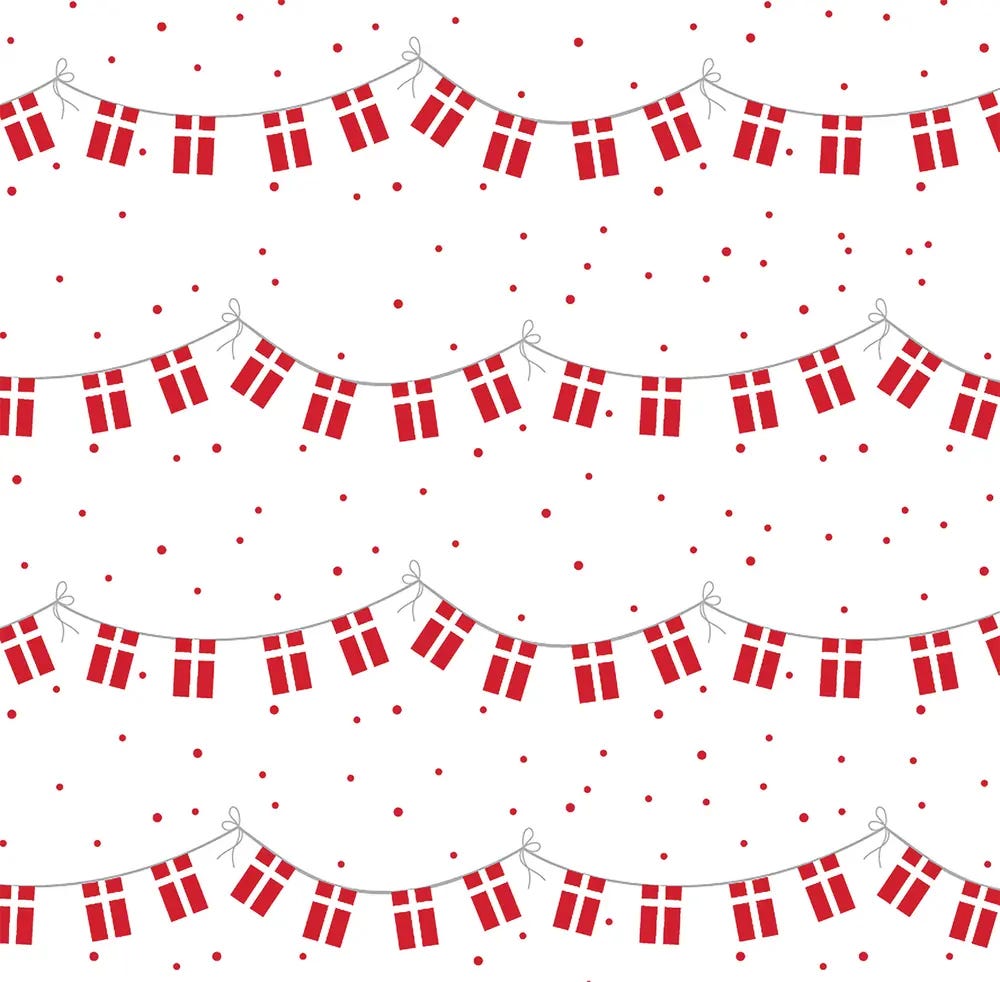
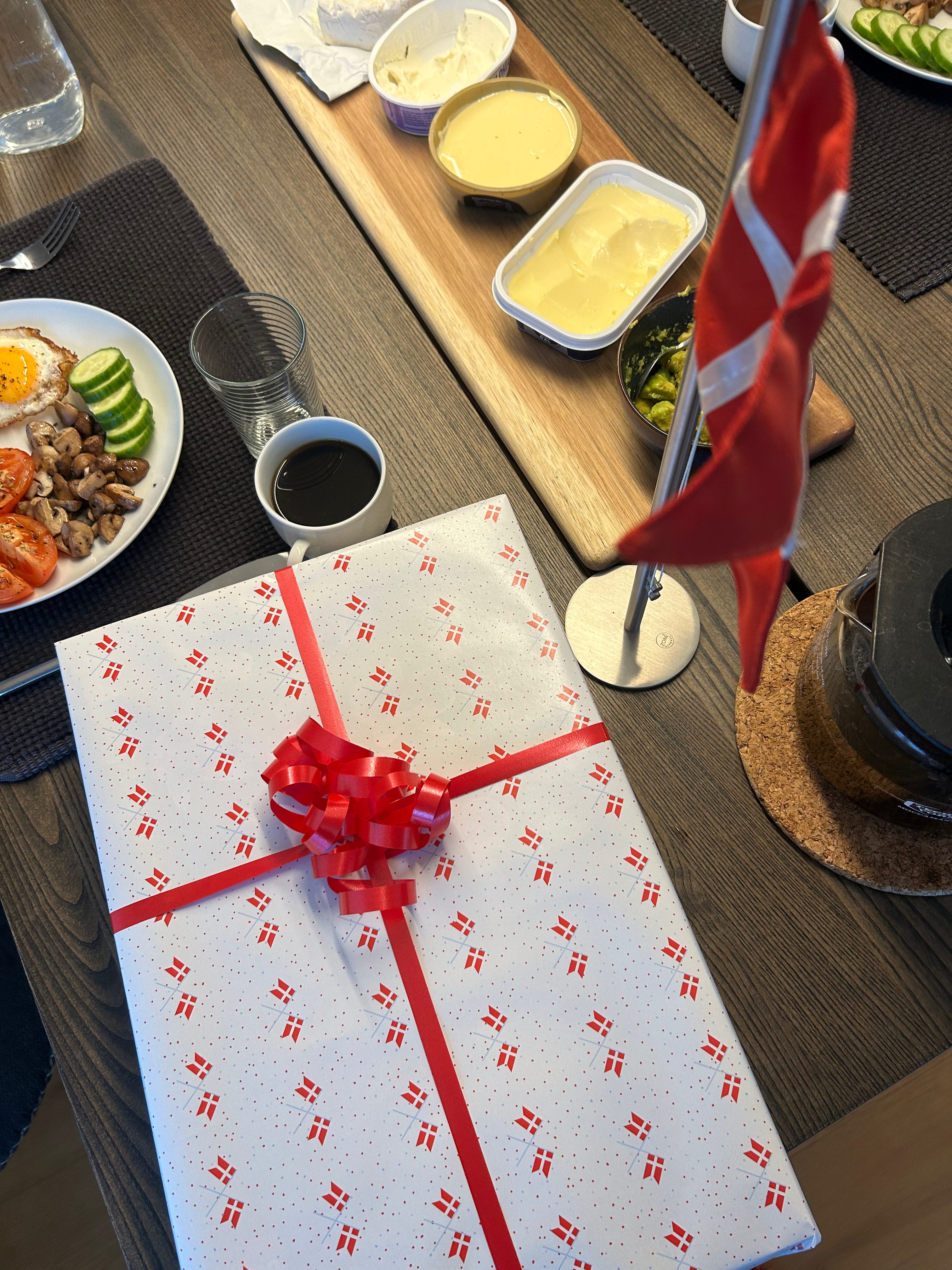
I turned forty today. I know this because when I came to the breakfast table this morning, a Danish flag was waiting for me. Not a paper one, not the disposable kind that tilts sideways in frosting — a real flag, or real enough, mounted on a stainless steel stand with the quiet authority of a thing that belongs exactly where it is. There were dozens more on the wrapping paper of a gift placed beside it — a repeating grid of tiny flags, white crosses on red, precise and joyful and relentless, as though the paper itself were trying to tell me something important about where I live. I unwrapped the gift carefully, the way you might handle any document covered in national symbols, which is to say, with respect and a faint, involuntary unease.
In China, waking up to a flag would mean you had overslept on a national holiday, or that something had gone very wrong in the night. Here, it means nothing more than happy birthday.
That the Danish flag belongs on a birthday table the way candles belong on a cake was, in fact, among the first few things I ever learned about Denmark. It arrived before the language, before hygge, before the bike lanes and the tax rate and the peculiar habit of leaving babies in strollers outside cafés in winter. Years ago, when I first bought a birthday cake at a bakery in Aarhus, I asked, out of instinct, whether they had candles. The girl behind the counter looked apologetic. “Sorry, we don’t have candles,” she said. “But we do have flags.” I thought this was a curious substitution. But I was new to the country, and the newly arrived learn early that confusion is not an emergency. I bought the cake without the flags and carried it to my friend’s apartment, feeling vaguely that I had failed. When I mentioned the missing candles, my friend looked confused — candles? — then reached into a drawer and produced a small handful of tiny paper flags, each no bigger than a postage stamp, mounted on little wooden sticks, and planted them across the frosting with the confidence of a general marking positions on a map. The cake, which moments before had been merely a cake, was now festive. It was now Danish.
The Dannebrog — “the cloth of the Danes” — may be the oldest national flag still in use. Legend has it that in 1219, during a crusade against the Estonians, King Valdemar II was losing badly when a red banner with a white cross fell out of the sky and reversed his fortunes. Whether this actually happened is beside the point. The Danes have been telling the story for eight hundred years, and they still like it — a flag sent from heaven, landing in the arms of a king, on a battlefield that would become Tallinn. It is a beautiful story. It is also, if you think about it for more than a moment, a story about a God who takes sides in a war. But nobody thinks about it for more than a moment. The flag fell from the sky, the Danes won, and now it goes on birthday cakes.
How a crusader’s war flag became the world’s friendliest decoration is a question the Danes do not seem to find interesting. The flag is simply described as a festive symbol first and a national symbol second. Its connection with birthdays and celebrations dates back to the early nineteenth century, and by now it has seeped so thoroughly into the texture of daily life that Danes seem scarcely to notice it. Using a fødselsdagsflag — a birthday flag — doesn’t signify any political stance or strong nationalist sentiment; it is a widespread tradition embraced by almost everyone. Some foreigners who are newly arrived interpret this as patriotism or nationalism, but the Danes themselves insist it is simply what happiness looks like when it needs a shape to take.
I should say here that I come from a country where the national flag does not appear on desserts. In China, the flag belongs to parades and government buildings and the particular strain of fervor that makes the back of your neck prickle. It belongs to compulsory flag-raising ceremonies at school, to patriotic education campaigns, to the vast and humming machinery of the state reminding you, at every turn, whom you belong to. You learn to read the flag the way animals learn to read the weather: not as decoration but as information, a signal about the atmospheric pressure of the state. When the flags go up, something is being demanded of you. Loyalty, usually. Silence, often.
There is a word for what this leaves you with, though it is not a very elegant one. It is a kind of post-traumatic sensitivity to national symbols — an allergy acquired through prolonged exposure. The China I grew up in taught me that national symbols are never neutral. They are instruments, as surely as a thermometer is an instrument, and what they measure is the temperature of power. A flag on a birthday cake in Beijing would not signal celebration. It would signal that something had gone terribly wrong — that the party had been requisitioned, that fun itself had been nationalized. If someone at a birthday dinner I attended in China had suddenly produced a flag and stuck it in the frosting, I believe I would have excused myself, gathered my coat, and left the building at a pace just short of running.
But here, in Denmark, nobody flinched. The children sang. The cake was cut. The little flags tilted sideways in the cream. It was, by every measure, an ordinary birthday.
I know what the Danes would say if I told them about my unease. They would say that their flag is different. That the Dannebrog is not the Chinese flag, that Danish nationalism is not Chinese nationalism, that a paper flag on a cake is not a loyalty test, and that I am projecting my own trauma onto their perfectly innocent traditions. And they would be largely right. The Dannebrog carries no threat. No one will be punished for failing to display it. It does not arrive with a knock on the door.
And yet there is, I think, a question buried inside the frosting, and it is a question the Danes, understandably, prefer not to dig out. When does a symbol stop being national and start being merely decorative? Can a flag truly shed its politics the way a snake sheds its skin — completely, cleanly, with nothing left behind? The trouble is that the flag doesn’t change. Only the eye looking at it does. So when I see the little Dannebrog standing upright in a birthday cake, I feel two things at once. I feel the charm of it — the smallness, the sweetness, the way a whole nation has agreed that a flag can mean nothing more ominous than someone in this room is turning seven. And I feel the old unease, the involuntary flinch, the voice in the back of my head that says: a flag is never just a flag.
And somewhere in the corner of every celebration, a person from a country where flags are not decorations but declarations is doing the math in her head, trying to subtract the menace from the symbol and finding, always, a small remainder she cannot account for.
Sometimes I think the remainder is not in the flag. It is in me. That somewhere between the schoolyard ceremonies and the compulsory applause, between the loyalty oaths recited before you were old enough to understand what loyalty meant, something was damaged — a small mechanism that, in most people, allows a flag to simply be a flag. A piece of cloth. A decoration. A way of saying happy birthday.
The Danes have that mechanism. They were born with it, or they grew up in a country gentle enough to leave it intact. When they see the Dannebrog on a breakfast table, they see love. When I see it, I see that too — but I see it through something, the way you see a landscape through a window that has a crack in it. The landscape is still beautiful. You just never stop noticing the crack.
I do not know if it can be fixed. I only know that some mornings — like this one, with coffee growing cold and a stainless steel flag catching the light and a gift wrapped in a hundred tiny crosses — it hurts a little less than it used to.