
The Dumpling Shop
Notes from Behind the Counter

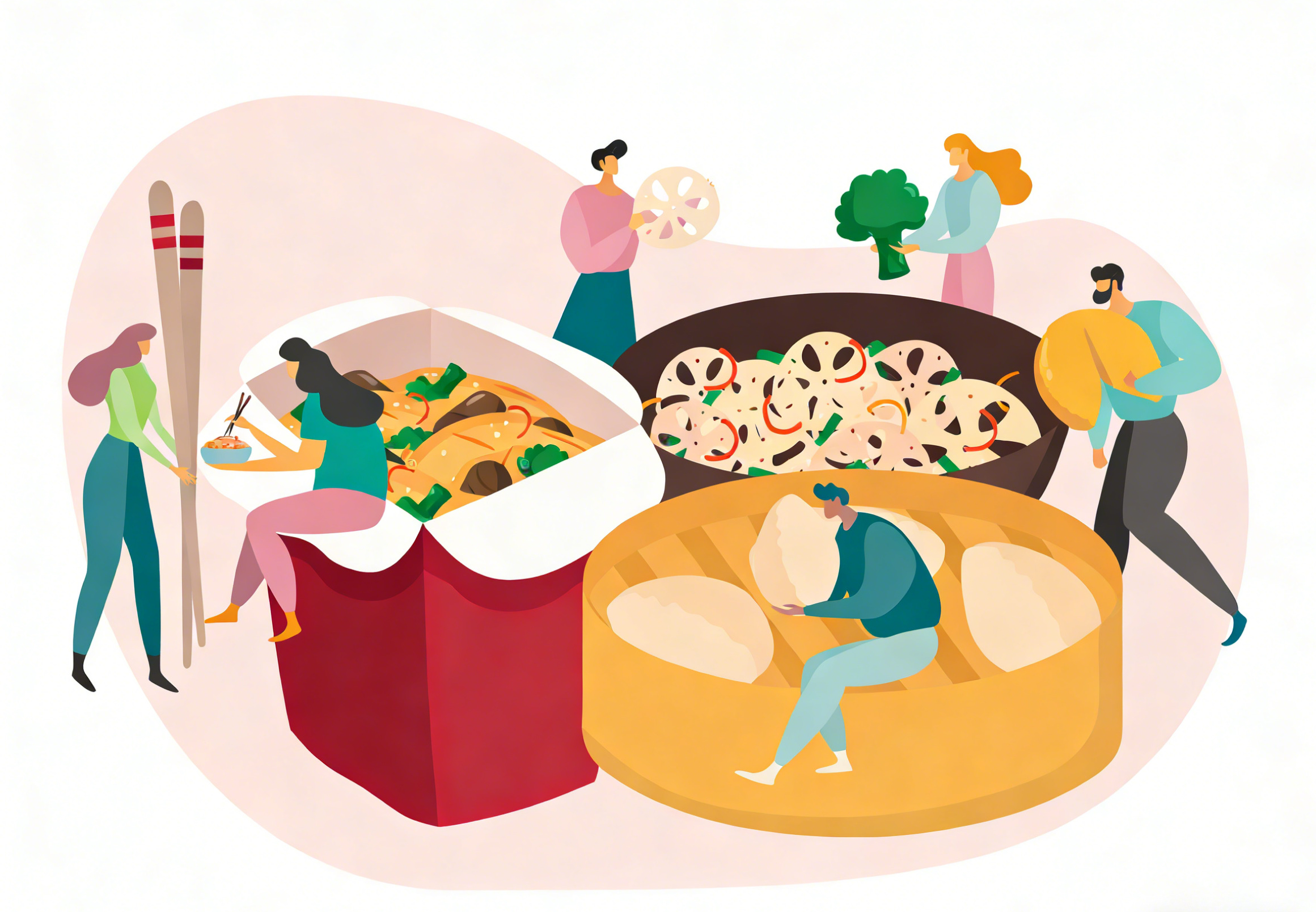
It’s six-thirty on a Saturday evening and the orders are stacked two rows deep on the rack. Summer heat pours through the food court skylights, mixing with steam from two large boiling pots and the particular sharp smell of oil hitting a hot pan. I’m taking orders, serving food, preparing sauces for dumplings and noodles. Reham is cooking. On the side, gyoza sizzle in a pan, their bottoms turning golden. We don’t speak much during rush hour. There’s no time.
I started this job last summer, not entirely for the money. The hours were flexible, which mattered, but mainly I wanted to see how this world worked. Like those literary types who dream of opening a café, I was curious about the mechanics of it: how a restaurant actually runs, what it takes to feed people for a living. I work mostly with two women: Allanes, from the Philippines, and Reham, from Syria.
The rhythm is simple once you learn it. Winter is slow. Midweek is slow. Weekends from six to seven are different. In summer and fall, during Danish holidays, that single hour can wreck you. Orders fill both racks. Your feet don’t touch the ground. By the end of a shift, you smell like oil and garlic and something else, something fried and vaguely sweet that clings to your hair. The long shifts run nine hours with a half-hour break and a free meal. Short shifts are four hours straight through. You take what you can get.
The money varies wildly. On a busy Saturday in summer, we might take in over twenty thousand kroner. On a quiet Wednesday in winter, a few thousand. You learn not to count on it.
What you can count on is the people around you. A friend once told me that in Denmark, the most important relationship you can cultivate is with your building’s caretaker. Bring them pastries, he said. Small bribes. They’re the ones who can actually solve your problems. The food court operates on the same principle, except here the currency is food itself.
We swap meals. That’s the term—swap. Instead of eating what we make all day, we trade with the other stalls. I’ll exchange our dumplings for Vietnamese pho, for falafel, for whatever the Mexican place is serving. It’s a small system of mutual relief from our own menus.
Then there are the extras, the unexpected gifts. The pizza place next door sends over their mistakes—a pie with a hole in the crust, a slightly burnt edge. Looks perfectly fine to me, but it can’t be sold. The girl who works there likes our dumplings, so these imperfect pizzas come our way as a kind of goodwill.
The Vietnamese place had a beef bao they were discontinuing, sales too slow. The last week it was on the menu, the cook just brought them over. “Try this,” he said. “Tastes like beef jerky. I don’t understand why people didn’t like it.” I didn’t understand either. It was good.
Sometimes it’s free salad, ice cream, or cake. Sometimes it’s the takeout orders nobody picked up, paid for but abandoned. Those I take home. Perfectly good food that would otherwise go in the trash.
This is how it works in the food court: a formal economy of swapped meals and an informal one of shared surplus, of things that don’t quite meet the standard but feed us anyway.
I’m part-time, mostly weekends. Reham and Allanes are full-time. So are most of the people here—Indians, Nepalese, Uruguayan. A small United Nations assembled in a food court in Denmark. The young Danes, when they work in food, tend toward the trendy coffee shops and salad bars. Back in the kitchens, it’s mostly immigrants. We’re the ones feeding people cheaply—the way the Turks feed Berlin with döner, the way every city gets fed by people from somewhere else.
And the people we feed don’t always know what they’re eating. The Danes who come to our counter can’t always tell the difference between Chinese, Japanese, and Korean food. To them it’s all “Asian,” which is fine, more or less. We sell proper northern Chinese dumplings and wontons, scallion pancakes the way they’re made in Shanghai. But we also sell gyoza. And wakame. And edamame. And chicken karaage. Nobody seems to notice or mind the mixing.
I’m amused watching Danish customers try to pronounce “dandan” or “yangchun” or “zhajiang”—these semantically opaque words met with awkward, polite smiles on both sides. Our yangchun noodles come topped with five Japanese-style gyoza, a combination I’ve never seen in any restaurant in China. But this might be some Danish person’s lifelong understanding of yangchun, of Chinese food in general. Still, it’s exposure to another culture. Better than only eating potatoes, anyway.
Most Danes have mild palates. They can’t handle spice. “Is this strong?” That’s the question they ask most often, pointing at menu items with a cautious finger. And yet the dandan noodles are popular. Who doesn’t like that burn, that rush of heat? They just ask for less chili oil. We oblige.
When it’s slow—winter afternoons, Wednesday evenings—we talk. Reham wants to move to the Netherlands. Allanes just got her driver’s license. Someone mentions prenuptial agreements, how shocking the idea seemed at first, how it changes your thinking about marriage, especially for us non-European women. Believe it or not, this is where you hear the most straightforward talk about feminism. Not theory, just practical thoughts about liberation and independence. We complain about customers, about the weather, about our feet, about management, about everything. It feels like hanging out with friends, the temporary intimacy of people thrown together by circumstance and payroll.
There’s a statistic: in the United States, immigrants make up nearly a third of all restaurant workers, though they’re only seventeen percent of the workforce overall. In some cities, the number in kitchens runs above seventy percent. We’re not just labor but the ones who bring the food itself—the techniques, the recipes, the particular way of folding a dumpling or rolling dough. Here in this food court, you can see it. We’re the ones who know how to make things people want to eat, even if they can’t pronounce what they’re ordering.
Last Saturday evening in winter, I walked out after a long shift. Snow was falling. The pavement had turned to ice. My clothes smelled like fryer oil and soy sauce. We were rushing to catch the bus—miss it and you wait another fifteen minutes in the cold. Reham pulled her coat tight. Allanes was already half-running toward the stop.
We’d see each other again next Saturday. The food court would be there, the orders stacking up, the steam rising from the pots. For now, I was just tired and hungry and trying not to slip on the ice, watching my breath cloud in the winter air, heading home.