
Yarn and Pixels
On knitting, pixels, and the countries that claim us

It was an ordinary afternoon, I went to the Asian supermarket near the train station — the one that carries the particular kind of tofu that no Danish supermarket stocks — and I was on my way back, bags in both hands, thinking about nothing in particular, when I saw them.
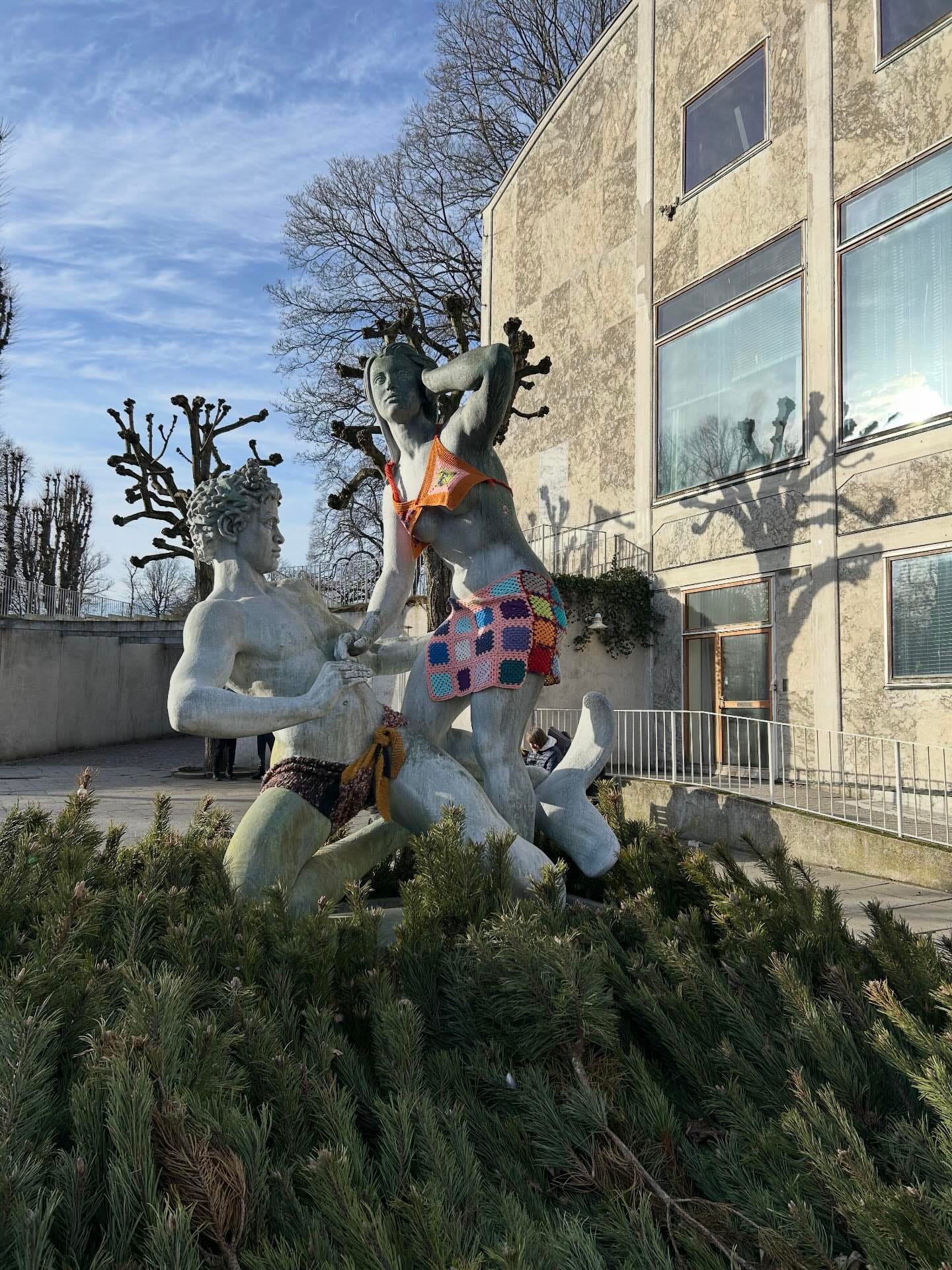
Two stone figures in a square: a man and a woman, frozen mid-struggle or mid-dance, it was hard to tell. The woman had been given a patchwork skirt in purples and pinks, and an orange crocheted bikini top. The man had been fitted with a small pair of knitted shorts. Against the flat grey of a January sky, they looked almost festive — a little absurd, a little tender, the way handmade things often do when they appear somewhere you don't expect them.
I set down my bags and took a photo. I posted it. Interesting, I wrote, or something like that. Then I picked up my bags and caught my train, and didn't think about it again for several days.
***
A few days later I was at my friend Emma’s for dinner, and I mentioned I wanted to learn to crochet. She asked what I’d like to make. I showed her the photo.
She put down her drink and told me the story behind it.
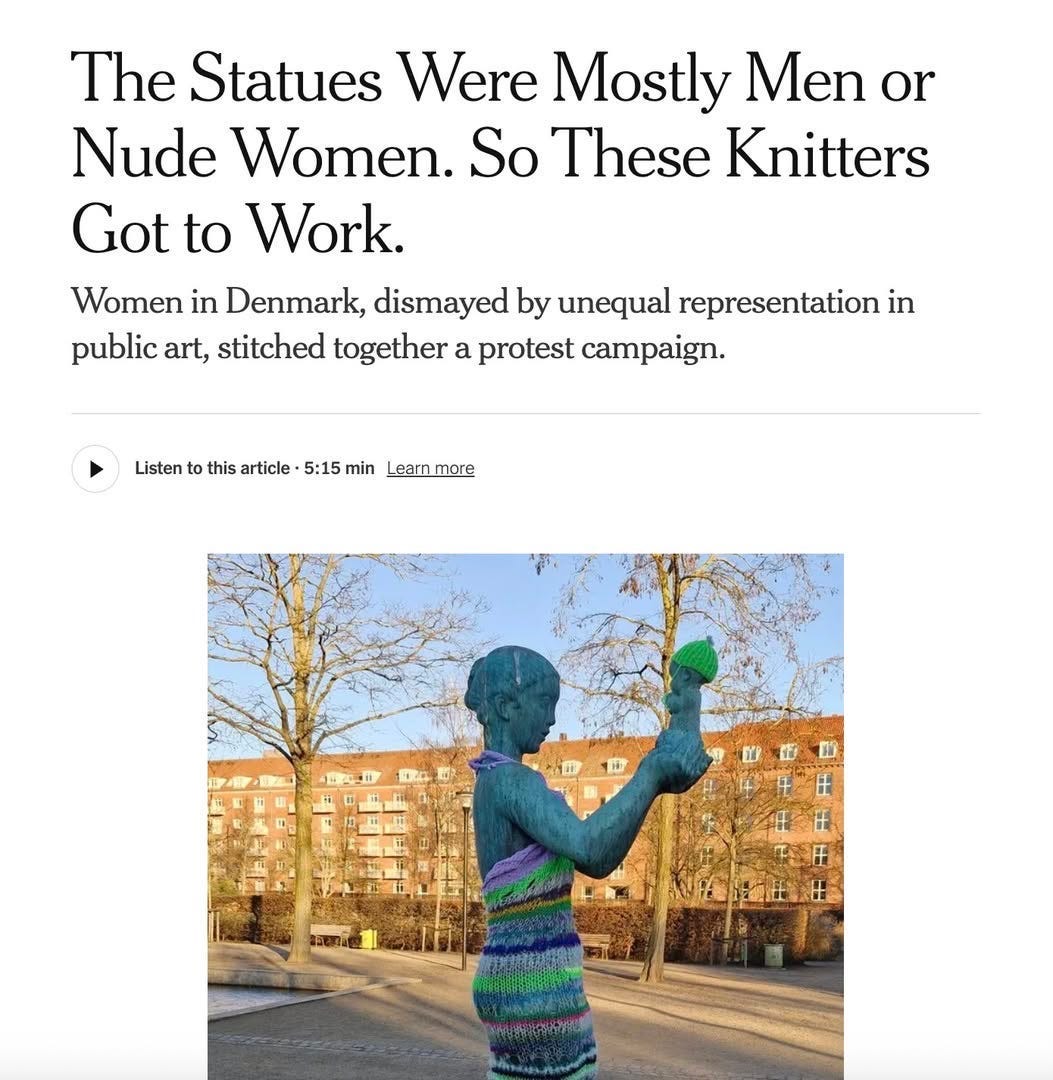
The statues across Denmark — hundreds of them — had been catalogued. Four hundred and eighty-four monuments depicting historically significant men. Forty-three depicting women. And over a hundred female nudes, anonymous and allegorical, representing myths and ideas and nothing in particular. Women knitters and crocheters around the country had begun dressing them: sweaters, skirts, bikinis, scarves. The government had taken notice. A million and a half dollars had been set aside for new monuments commemorating historically significant women.
I looked at my photo again. The woman in the patchwork skirt. The man in his modest knitted shorts. I had thought it was art. It was also an argument.
I admired it. I still do. There is something genuinely moving about this form of protest — its patience, its humor, its refusal of rage. You don’t tear the statue down. You dress her. You make the point with yarn. The government writes a check. The museum takes the dress for its collection. Democracy, functioning more or less as advertised.
But sitting at Emma’s table, I also felt something else, some small resistance I couldn’t quite name. What a particular kind of problem to have, I thought. What a particular kind of country, where this is what feminism looks like.
I have been living in Denmark for some time now, and it is — I want to be accurate about this — genuinely good for women. I attended a conference here not long ago, co-hosted by the Danish Ministry of Foreign Affairs, and looked around the room at the officials who had come to speak, and realized that the overwhelming majority of them were women. Not as an exception. Not as a deliberate statement. Just as a fact, unremarkable, the way things are. I have walked through the cities at night without thinking twice. I have been taken seriously in rooms where I expected not to be. There are role models here in the literal, structural sense: women in positions of authority, visible enough that a girl growing up here can see what is possible and believe it.
I know what this is worth. I have not always lived somewhere it was true.
And yet.
I went to a gynecologist here about four years ago to have an IUD fitted. The doctor was a woman, efficient and kind, and at some point during the examination she looked up and said, almost conversationally: You have a beautiful uterus. You could still have children, you know.
I lay there on the table and felt something I struggled afterward to describe. Not quite offense. Not quite surprise. Something more like recognition — the sensation of being seen, not as a person who had come in with a specific medical request, but as a vessel being assessed for its fitness. In Denmark. By a woman doctor. In the most gender-equal country in the world, by most measurements.
I thought about the numbers Emma had told me. Four hundred and eighty-four men. Forty-three women. A hundred and twenty anonymous female nudes.
The welfare state will give you childcare, I thought. It will not give you stone. And it will, if you give it the chance, remark upon your uterus.
About six or seven years ago, when I could still use Weibo, I used to post frequently about gender. I was never, by Chinese social media standards, particularly radical. I thought feminism meant protecting women’s right to choose — to work, to stay home, to marry, to not marry, to want whatever they wanted without a movement telling them their choices were wrong.
This turned out to be a controversial position.
I was attacked from two directions simultaneously. The first was the predictable one: the trolls who showed up on any post about gender to deploy the coarsest possible language, who treated any woman who named a social problem as a problem herself, to be dealt with accordingly. I had expected them. They were unpleasant and, in a certain grim way, legible.
The second group surprised me more. They came from within what called itself feminism — women who had concluded that marriage was slavery, that any woman who chose it was either a victim or a collaborator, that defending women’s right to choose included everything except the choice to marry, which was not a real choice and therefore didn’t count. They had a word for married women, a word I won’t repeat here. They attacked me for saying I thought women should be free to make that choice too.
I was angry at the time. I am not angry now.
I had grown up with the protections I’d been given — the education, the options, the structural buffers that kept the worst from reaching me directly. My relationship to feminism had always been, at some level, theoretical. I could afford to think in principles. They could not.
For them, the reality of being a woman in China was not a principle. It was the knowledge that a family might decide a daughter was worth less than a son before she was old enough to have an opinion about it. It was the understanding that if a boyfriend or husband hurt you, the system would not necessarily be on your side. It was the calculation, made every day, of which streets and which hours and which situations were navigable. It was the news that came in a steady stream — women followed, women harassed, women killed, the men who did these things receiving sentences that made the math of it clear.
It was the woman in Xuzhou, in 2022, chained by the neck in a shed, who had borne eight children. She had been trafficked decades earlier, possibly as a teenager, and sold as a wife. The local government initially claimed she was a mentally ill vagrant. The hashtags kept being deleted. The outrage kept returning.
That same year, on Reddit, there was a social experiment called r/place: a vast shared canvas, millions of pixels wide, on which anyone in the world could place a single colored square every few minutes. It became, inevitably, a kind of war — communities fighting for territory, alliances forming and collapsing, images built and destroyed and rebuilt in the span of hours.
In one corner of that canvas, a group of Chinese dissidents spent days constructing a pixel portrait: a woman’s face, rendered in blue and white, a chain and padlock at her throat. Around her, in blocky capital letters: SAVE TRAFFICKED WOMEN IN CHINA. At the bottom, a phrase borrowed from a student at Tiananmen Square in 1989: THIS IS MY DUTY.
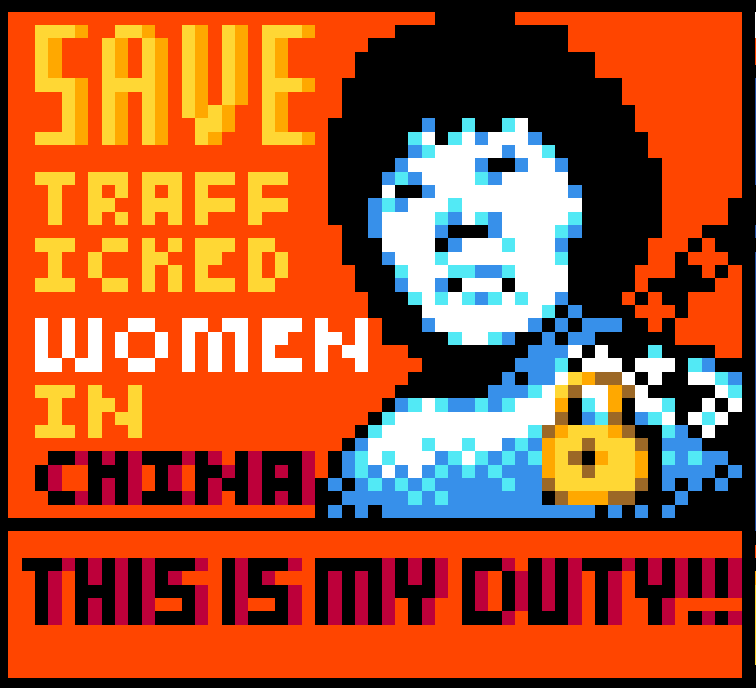
Other users tried to erase it. They changed pixels, overwrote the face, turned words into nonsense. The dissidents rebuilt it, square by square, coordinating across time zones, defending each point of color against deletion. The mural survived to the final canvas.
I think about this alongside the knitters in Denmark — the careful stitches, the patchwork skirts, the government check for a million and a half dollars. Both are forms of handcraft. Both are ways of making something visible that power would prefer to leave unmarked. But one happened in a public square in the most gender-equal country in the world, and the government responded with funding. The other happened on a digital canvas that exists nowhere physically, made by people who could not protest in any square that mattered, fighting pixel by pixel to keep one woman’s face from being erased.
The knitting is beautiful. The pixel mural is also beautiful, in its way — the way that pure stubbornness can be beautiful, the way that making something with your hands in defiance of someone trying to unmake it is always, at some level, an act of love.
When I read about the woman in Xuzhou, I thought: there are women who experience feminism as a philosophical position and women who experience it as the difference between life and death. I had been, in almost every way that matters, the first kind. To ask the second kind to be moderate and reasonable and strategic is to ask them to treat their own survival as a matter for considered debate.
I didn’t agree with everything those women said on Weibo. But I understood, finally, that my disagreement was a luxury I had purchased with a life they hadn’t been given.
**
Virginia Woolf wrote, in 1938, that as a woman she had no country. She meant it precisely: the nation had never offered women belonging, only use. Protection in exchange for compliance. Inclusion in exchange for productivity. The country that honored your labor would assess your uterus. The country that built four hundred and eighty-four monuments to men would set aside a million and a half dollars for women’s monuments once the knitters made the point impossible to ignore — and would call the timing a coincidence.
In Chinese, among women of a certain age and internet history, a version of this sentence circulates too. Women have no country. It means something sharper there, because the country in question has made its terms so much more explicit. But I think Woolf would recognize the underlying logic across all of it: from the shed in Xuzhou to the gynecologist’s table in Denmark, the premise is the same. The woman is the resource. The question is only how the resource is managed.
Denmark manages it gently. Generously, even. The lesser evil is still evil, but it is evil you can live inside, which is not nothing. I want to be honest about that. I walk through the country and I feel something I can only call relief — not triumph, not justice, but relief — and I know enough to know that relief is not available everywhere, and that knowing this is itself a kind of privilege.
**
Today is International Women’s Day. I am looking again at the photo I took in the square — the patchwork skirt, the orange bikini top, the blue sky. The woman in stone, dressed now in someone’s careful handiwork, standing in the cold.
She will be undressed eventually. The museum will want the yarn. The argument will continue.
I think about the women in Afghanistan who cannot go to school, and the women in Iran who have taken off their headscarves in the street and accepted what comes next, and the women on Chinese social media writing names on their hands so the names stay visible for a few hours before they are erased. I think about the women who attacked me on Weibo, whose anger I misread for a long time as excess and now understand as information. I think about Emma, who knew what the statue meant. I think about myself on the examination table, being assessed.
What I want, for all of us, is not the lesser evil. It is not the gentle management of our potential. It is not monuments, though monuments are better than their absence.
What I want is harder to name and further away. The freedom to be something other than useful. The freedom to be difficult, ordinary, furious, unproductive, unchosen — and to have that be, simply, enough.
I don’t know what that world looks like. I have not seen it anywhere yet.
But someone is still picking up her needles. And somewhere else, someone has written a name on her hand and is holding it up to the camera before it disappears.
It is the same gesture, I think, made at different distances from the fire.
(A note: this essay began, as most things do, with a conversation. Emma, who taught me to crochet and first told me what the statues meant — thank you. I have not yet decided what to make.)